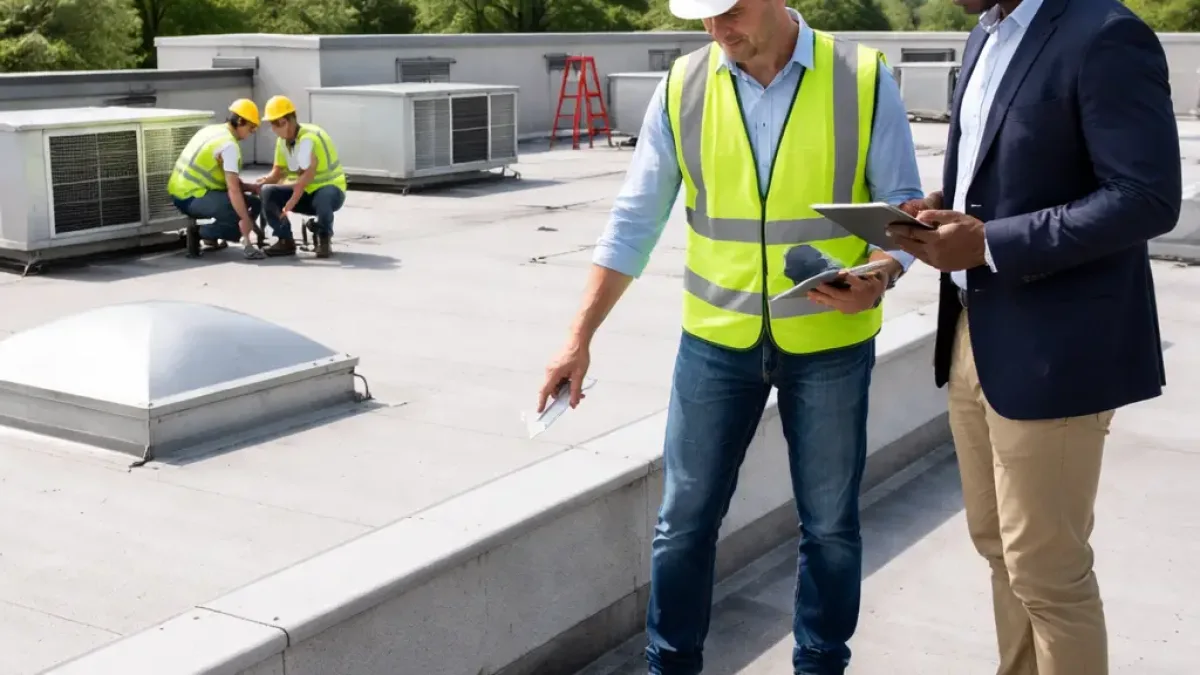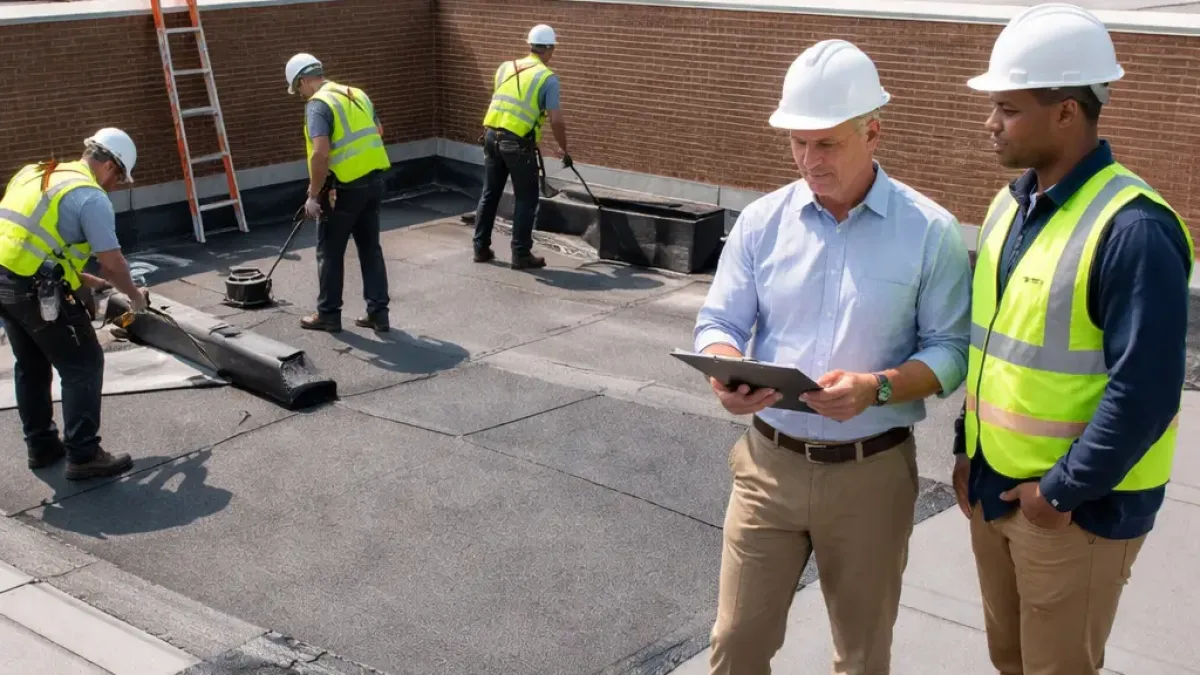
A leaking modified bitumen roof in Newark, ponding water on a warehouse in Edison, or loose flashing on a retail center in Cherry Hill usually calls for a practical decision: repair the problem areas now, or evaluate whether restoration makes more sense. For New Jersey commercial property owners, the right answer depends on the roof’s age, surface condition, seams, drainage, penetrations, and how much of the system is still performing well.
Aaron Blake Commercial Roofing helps New Jersey property owners with modified bitumen roof repairs, restorations, inspections, and related commercial roofing services. With more than 30 years of experience serving the state, the company works on many building types, including warehouses, schools, churches, multifamily properties, industrial buildings, and retail centers. The main takeaway is simple: a modified bitumen roof that is structurally stable and mostly sound may be repairable or a candidate for restoration, while widespread membrane breakdown, repeated leaks, or major drainage problems may push the conversation toward replacement planning.
For a system overview, see Modified Bitumen.
Quick answer: when a modified bitumen roof can usually be repaired vs. when restoration may be worth evaluating
Modified bitumen roofs are often repairable when the issue is limited to a few seams, localized flashing failures, a small number of punctures, or a known leak area that can be traced and opened up safely. Restoration may be worth evaluating when the roof still has usable life, the membrane is broadly intact, and the main problems are aging, surface wear, minor cracking, or scattered repairs that are adding up.
Repair is usually the first conversation when the roof has one or two problem areas. Restoration becomes more relevant when the roof is not failing everywhere, but it needs more than a simple patch-and-go approach.
Takeaway: If the roof is mostly intact, modified bitumen repair or restoration may be practical; if damage is widespread, the next step may be a broader replacement discussion.
What modified bitumen roofing is and why it is used on many New Jersey commercial buildings
Modified bitumen is a multi-layer commercial roofing system made to handle regular weather exposure, foot traffic, and building movement better than many lighter-duty membranes. It is commonly used on low-slope roofs across New Jersey because it can be installed in different ways and can be paired with details that suit many building conditions.
On properties from Hoboken to Secaucus, and from Paterson to Bayonne, building owners often choose modified bitumen for practical reasons: the roof profile is low-slope, the building sees service traffic, and the structure needs a system that can be maintained over time.
Modified bitumen systems are often considered alongside SBS and other commercial roof types. If you are comparing options, Aaron Blake Commercial Roofing also discusses SBS Cold Process and Built-Up Roof Repair for NJ Commercial Properties and Torch Down Roofing where that context helps.
Takeaway: Modified bitumen is popular because it is durable, serviceable, and often practical for low-slope New Jersey commercial roofs.
Common signs a modified bitumen roof may need attention
Most roof problems do not start with a dramatic failure. They often begin with small signs that are easy to overlook during a busy week.
Interior warning signs
- Water stains on ceiling tiles or interior gypsum
- Drips near walls, columns, or mechanical rooms
- Musty odors that may point to trapped moisture
- Peeling paint or rust where water has traveled
- Discoloration after storms or snow melt
Exterior warning signs
- Cracked or brittle membrane surfaces
- Open seams or lifted overlaps
- Bubbling, blistering, or alligatoring in aged areas
- Damaged base sheets or worn cap layers
- Patchwork repairs that are separating again
Drainage and flashing issues
- Ponding water that remains after rain
- Clogged drains or scuppers
- Loose or deteriorated flashing at edges and walls
- Open details around skylights, curbs, vents, and HVAC units
- Traffic wear near service paths and rooftop access points
For a roof with repeated symptoms, the question is not only where the leak appears, but why the water is getting in. That distinction helps determine whether a repair can hold or whether broader restoration work should be evaluated.
Takeaway: Interior stains, seam issues, ponding water, and flashing damage are all early signals that a modified bitumen roof needs attention.
Repair vs. restoration: how the decision is usually made
Property managers often want a simple yes-or-no answer, but roof decisions are usually based on a few practical factors. The best choice is usually the one that matches the roof’s actual condition, not just the visible leak.
| Factor | Repair often makes sense when | Restoration may be worth evaluating when |
|---|---|---|
| Roof age | The roof is younger or middle-aged and has localized issues | The roof is older but still broadly serviceable |
| Membrane condition | Most of the membrane is intact | Surface wear is present, but the system is not failing everywhere |
| Seams and flashing | Only a few details are compromised | Many details need attention, but the roof is still workable |
| Drainage | Drainage is functional with minor corrections | Drainage can be improved as part of a broader plan |
| Building use | Short-term stability is the goal | The owner wants a longer planning window without immediate replacement |
Roof age and overall condition
Age matters, but it should not be the only factor. A roof can be older and still have enough remaining condition to justify targeted repairs or a restoration review. On the other hand, a newer roof with major installation-related problems may need more than a patch.
Membrane type and existing layering
Modified bitumen roofs can be built with different assemblies, and the existing layering affects what can be done next. Too many prior patches, incompatible materials, or a roof assembly that has already been worked on repeatedly may limit the value of additional repairs.
Drainage, seams, flashings, and penetrations
Many modified bitumen leaks begin at seams, flashings, pipe boots, curbs, and other penetrations. If those areas are the main issue, a focused repair may be appropriate. If many details are failing, the roof may need a wider restoration strategy.
Building use, access, and budget considerations
A warehouse in Perth Amboy with frequent roof traffic has different needs than a church in Morristown or a school in Princeton. The building’s use, the ability to access the roof safely, and the owner’s planning horizon all influence whether repair or restoration is the more practical option.
Takeaway: The repair-versus-restoration decision is usually based on condition, not guesswork.
Typical modified bitumen repair approaches
When a roof is still in usable shape, repairs are usually focused on the source of the problem rather than the symptoms inside the building.
Seams and blister repairs
Open seams, separated laps, and blistered areas can sometimes be repaired by opening the affected section, removing damaged material, and reinstalling the detail correctly. The exact approach depends on the roof condition and the extent of damage.
Flashing and penetration repairs
Flashing failures around parapet walls, skylights, HVAC curbs, vents, and pipe penetrations are common on commercial roofs. A careful repair often starts by tracing the leak, exposing the failed detail, and rebuilding that area in a way that fits the existing system.
Localized leak repairs and patching
Localized patching can be helpful when a leak is isolated and the surrounding membrane is still performing. The goal is to address the source of the water entry, not simply cover the visible symptom.
For broader project planning, see roof repairs and restorations.
Takeaway: Good repairs are specific, targeted, and based on the actual failure point.
What a modified bitumen restoration may involve
A restoration is different from a small repair. It usually starts with preparation, correction of problem details, and then a restore system or coating approach if the roof is a suitable candidate.
Surface preparation and repair work first
Before any restoration layer is considered, the roof usually needs cleaning, drying, and repair work at seams, flashings, penetrations, and damaged areas. A restoration should not be used as a shortcut over unresolved leaks or unstable sections.
Restore systems and coating considerations
For some buildings, a restore system can help extend the useful life of a modified bitumen roof while improving surface performance. The right choice depends on roof condition, slope, drainage, traffic, and the existing membrane. For owners comparing reflective options, trusted resources such as the Department of Energy Cool Roofs, EPA Cool Roofs and Heat Islands, and ENERGY STAR Cool Roofs can help explain how surface reflectivity may affect heat gain. Building owners can also review the Cool Roof Rating Council Building Owner Resources.
If you want a broader view of these options, see roof restoration systems.
When restoration is not a fit
Restoration is not the right answer for every roof. It may be a poor fit if the membrane is too deteriorated, moisture is widespread, drainage problems are severe, or there are too many unstable details to correct effectively. In those cases, a qualified roofing contractor should explain the limits clearly.
Takeaway: Restoration can be useful, but only when the roof is a sound enough candidate to support it.
Inspection checklist for NJ property managers and owners
Before calling for service, it helps to gather a few notes. That information makes the inspection more productive and can help the contractor focus on the most likely trouble spots.
What to document before calling a contractor
- Where the leak shows up inside the building
- When the problem started and whether it follows rain or snow melt
- Any recent rooftop work, HVAC service, or foot traffic
- Photos of stains, blisters, ponding water, or visible flashing damage
- The approximate age of the roof, if known
- Past repair locations, if your maintenance records show them
What to ask during the inspection
- Is the issue localized or part of a broader membrane condition?
- Are the seams, flashings, and penetrations still in workable shape?
- Does drainage need correction before any repair or restoration?
- What parts of the roof show the most wear or traffic damage?
- Would annual maintenance help reduce repeat problems?
Building safety, code, OSHA, and structural concerns should be reviewed with qualified professionals and official sources. Roof access and fall protection topics can be reviewed through OSHA Fall Protection in Construction, and code or permit questions should be verified through official New Jersey sources such as the New Jersey Uniform Construction Code. For contractor information resources, see the New Jersey Division of Consumer Affairs Home Improvement Contractors.
Takeaway: A short document-and-inspect checklist can make the next step clearer for owners and managers.
Local considerations for New Jersey buildings
Different parts of New Jersey create different roof conditions. That is one reason a modified bitumen roof in one city may need a different approach than a similar roof elsewhere.
Urban rooftops in Newark, Jersey City, Hoboken, and Bayonne
Urban rooftops often have tighter access, more rooftop penetrations, and more visible wear around mechanical equipment. On these buildings, seams, edge details, and traffic paths deserve close attention. A roof inspection can also help identify areas that are being stressed by ongoing service access.
Industrial and warehouse roofs in Edison, Woodbridge, Secaucus, and Perth Amboy
Warehouses and industrial buildings often have larger roof areas, more drains, and more utility penetrations. Ponding water, clogged drainage, and repeated service traffic can accelerate wear on modified bitumen systems if they are not maintained.
Retail, school, church, and multifamily roofs across Middlesex, Bergen, Essex, Union, Camden, Monmouth, and Ocean County
Buildings with regular occupancy and service schedules often need repairs planned around tenants, staff, or congregants. In places like New Brunswick, Plainfield, Hackensack, Clifton, Paramus, Toms River, Trenton, Princeton, Cherry Hill, Camden, Atlantic City, Morristown, Freehold, and Red Bank, roof work often has to balance access, noise, and building operations.
If you want to confirm coverage in your area, review the New Jersey service area.
Takeaway: New Jersey roof conditions vary by building type, access, and local exposure, so the inspection should fit the property.
Why annual maintenance helps extend modified bitumen roof life
Annual maintenance does not remove the need for repairs, but it can help catch small issues before they become larger ones. For modified bitumen roofs, maintenance often focuses on seams, drainage, flashing, debris, and traffic wear.
- Clear drains, scuppers, and gutters if they are part of the system
- Check seams and flashing after significant weather
- Look for punctures near service routes and rooftop equipment
- Document ponding areas that persist after rain
- Track recurring leak points so patterns are easier to see
Property owners can review Aaron Blake Commercial Roofing’s annual maintenance programs as part of a practical roof care plan.
Takeaway: Regular maintenance helps owners spot small roof problems before they become repetitive leak issues.
When to schedule repairs or a roof inspection
It is usually time to schedule a roof inspection when you notice a new leak, repeated staining, ponding water that is not changing, lifted flashing, or visible membrane wear. It is also smart to schedule an inspection after severe weather, rooftop equipment work, or any period of heavy roof traffic.
If the roof has a mix of older patches, seam issues, and drainage concerns, a restoration review may be worth discussing before the damage spreads further. For properties in New Jersey, a prompt visual review can help clarify whether the roof is best handled with a targeted repair, a broader restoration plan, or a replacement conversation for later planning.
Takeaway: New leaks, persistent ponding, and damaged flashing are strong reasons to schedule an inspection.
Why property owners choose Aaron Blake Commercial Roofing
Aaron Blake Commercial Roofing works with commercial property owners and managers across New Jersey who need straightforward answers about modified bitumen roofs. The company handles roof repairs, restorations, annual maintenance, and related general construction services, and it works across many commercial roof types and building conditions.
That matters because the best roofing recommendation usually comes from understanding the whole roof, not just one leak. Whether the property is a retail center in Paramus, a school in Elizabeth, a church in Morristown, a multifamily building in Red Bank, or a warehouse in Secaucus, the practical question is the same: what is the roof condition now, and what is the most reasonable next step?
Learn more about commercial roofing services or review broader commercial roofing and construction services.
Takeaway: The right contractor should explain the roof’s condition clearly and recommend the next step based on what the roof actually needs.
FAQ
What is the difference between modified bitumen roof repair and roof restoration?
Repair usually addresses a specific issue such as a seam failure, flashing problem, puncture, or isolated leak. Restoration is broader and usually involves preparing the roof, correcting problem areas, and then applying a restore approach when the roof is a suitable candidate.
How do I know if my modified bitumen roof can be repaired instead of replaced?
If the membrane is mostly intact, the damage is localized, and the underlying roof condition is still stable, repair may be practical. If the roof has widespread cracking, repeated leaks, major moisture issues, or significant deterioration, a contractor may recommend a wider planning conversation.
What are the most common leak points on modified bitumen roofs?
Common leak points include seams, flashing transitions, roof penetrations, parapet details, curbs, drains, and areas with repeated foot traffic or mechanical service activity.
Can a restoration help extend the life of a modified bitumen roof?
It can, if the roof is a good candidate and the system is prepared correctly. Restoration is not a fix for every roof, so the membrane condition, drainage, and prior repairs all matter.
How often should a commercial modified bitumen roof be inspected in New Jersey?
Many owners schedule at least annual maintenance and inspection, with additional checks after major storms, rooftop equipment work, or any time a leak appears.
Do drainage issues affect whether a modified bitumen roof is a good candidate for restoration?
Yes. Drainage affects roof performance and can influence whether restoration is practical. Persistent ponding or blocked drainage may need correction before any restoration decision is made.
Can Aaron Blake Commercial Roofing inspect modified bitumen roofs in Newark, Jersey City, Elizabeth, Edison, Woodbridge, New Brunswick, Paterson, Clifton, Hackensack, Hoboken, Bayonne, Toms River, Trenton, Princeton, Cherry Hill, Camden, Atlantic City, Morristown, Freehold, Red Bank, Paramus, and Secaucus?
Yes. Aaron Blake Commercial Roofing serves all of New Jersey, including those cities and surrounding areas. You can review the company’s areas serviced for more coverage details.
How do I request a roof inspection or free estimate from Aaron Blake Commercial Roofing?
Call +1 (732) 669-7545, email info@aaronblakecommercialroofing.com, or use the contact page to schedule a commercial roof inspection, repair consultation, restoration review, maintenance program discussion, or free estimate in New Jersey.
CTA
If your modified bitumen roof is showing leaks, ponding water, seam failure, or flashing issues, Aaron Blake Commercial Roofing can help you review the condition and next steps. Call +1 (732) 669-7545 or email info@aaronblakecommercialroofing.com to schedule a commercial roof inspection, repair consultation, restoration review, maintenance program discussion, or free estimate in New Jersey. You can also reach the team through the contact page.
Read more
- Modified Bitumen
- Roof Restoration Systems
- Roof Repairs and Restorations
- Annual Maintenance Programs
- Areas Serviced
For New Jersey commercial roofs, the most useful repair plan is the one that matches the roof’s actual condition, drainage pattern, and long-term use.
Schedule a commercial roof inspection or free estimate
Call Aaron Blake Commercial Roofing at +1 (732) 669-7545 or email info@aaronblakecommercialroofing.com to discuss commercial roof repair, restoration, maintenance, coatings, or exterior property maintenance in New Jersey.